The phrase instagram shadowban automation gets searched by two very different people: someone whose reach just cratered and wants to know if their DM tool caused it, and someone about to set up automation who is scared of getting restricted before they even start. Both deserve a straight answer, and the straight answer is not the one either the fear-mongers or the sales pages give you. DM automation, on its own, does not cause shadowbans. What causes restrictions is the method behind the automation and the behavior it produces — not the fact that a message was sent by software instead of a thumb.
This is a myth-versus-reality piece. We are going to separate the thing people blame (automation) from the things that actually trigger Instagram account restrictions (unofficial tools that log into your account, mass unsolicited outreach, spammy send patterns, and policy violations). We will show you what safe, official-API automation looks like, how to spot the warning signs of a restriction, and the basics of recovery if you already have one. We will also be honest about the limits — including the limit that applies to every tool, our own included: no software can promise Meta will never take action on an account.
Full disclosure up front: we build KlyoChat, an AI-native inbox that automates Instagram, Facebook, WhatsApp, Telegram, TikTok, and X using the official Meta Messaging API. That gives us a point of view, and it also gives us a reason to be precise rather than alarmist. Scaring you about automation in general would be dishonest, because the category we operate in is compliant by design. The category that gets accounts restricted is a different one, and telling the two apart is the whole point of this article.
What is a shadowban on Instagram, really?
A shadowban is the informal name for a quiet reduction in your reach or discoverability that Instagram never notifies you about. Your posts still exist, your account still works, but your content stops showing up in hashtag results, the Explore feed, or non-follower recommendations the way it used to. Nobody sends you a warning. You just notice engagement fall off a cliff and start wondering what you did wrong.
The important nuance is that Instagram and Meta have historically been careful about the word itself. In official communications the company tends to talk about limiting the reach of accounts or content that does not follow the Community Guidelines or the Recommendations Guidelines, rather than using the term shadowban. The mechanic that users experience — reduced distribution without a formal strike — is real, but it is better understood as a spectrum of enforcement than a single on-off switch. The broader concept has its own well-documented history across platforms, summarized in the public reference on shadow banning.
It also helps to separate a true reach-limiting event from the everyday noise of the algorithm. Reach naturally rises and falls. A post can underperform because the topic did not land, because you posted at a dead hour, because the format was off, or simply because distribution is variable. Before you conclude you have been restricted, you have to rule out ordinary volatility, and most people who panic about a shadowban are actually looking at a normal down week.
Shadowban is a user term, not an official one
Meta rarely uses the word shadowban. It talks about limiting reach or making content ineligible for recommendation when guidelines are not met. When you diagnose a problem, look for that framing in the Account Status tools rather than searching for a switch labeled shadowban.
Does DM automation cause shadowbans?
No — not as a category. The act of automating a direct message is not itself a violation, and Instagram's own platform provides an official way to send automated messages through the Messenger and Instagram messaging APIs. If automation were inherently against the rules, Meta would not publish a documented API for building it. The confusion comes from lumping two very different things under the same word.
When people say automation got their account restricted, what actually happened in the overwhelming majority of cases is one of a small number of specific behaviors: they used a tool that logged into their account with their username and password and simulated taps, they blasted unsolicited cold DMs to people who never asked to hear from them, they fired the same copied message at hundreds of accounts in a short window, or they used follow/unfollow and mass-DM growth hacks that trip Instagram's spam detection. The automation was the delivery mechanism, but the trigger was the method and the pattern.
Think of it like email. Nobody believes that email software causes spam filtering. Sending unsolicited bulk mail from a burner setup causes spam filtering. The same email tool used to reply to people who opted in and expect to hear from you sails through. Instagram automation works the same way: the safe version answers people who messaged you first and respects the platform's rules, while the risky version chases strangers and imitates a human logging in. We cover the specific patterns that get people in trouble in our guide to the most common Instagram DM automation mistakes.
Two setups, same word 'automation'
- Risky
- A browser bot logs into your account and cold-DMs 300 strangers with an identical pitch
- Safe
- An official-API tool auto-replies to people who commented or messaged you first, within policy
What actually triggers Instagram account restrictions?
If automation is not the real cause, what is? Instagram restrictions cluster around a short list of behaviors that all share one trait: they look like spam or abuse to an automated detection system, whether or not you intended them that way. Understanding this list is more useful than any blanket rule about automation, because it tells you what to actually avoid.
The single biggest one is unsolicited outreach at volume. Instagram is built around consent — people message accounts they want to hear from. When an account starts sending cold messages to people who never engaged with it, that pattern reads as spam almost immediately, and it does not matter whether a human or a bot typed it. Layer on identical repeated copy, links to off-platform destinations, and a high send rate, and you have assembled the exact profile Instagram's systems are tuned to catch.
The second is tooling that violates the platform's terms by controlling your account directly. Anything that asks for your Instagram password, logs in as you, and mimics human taps is operating outside the sanctioned API. Even if your messages are perfectly polite, the login pattern itself — a data-center IP driving your account, actions at inhuman speed or regularity — is a red flag independent of content.
- Mass unsolicited DMs to people who never engaged with you first.
- Identical, repeated message copy fired at many accounts quickly.
- Tools that log in with your password and simulate human taps.
- Aggressive follow/unfollow and mass-like growth loops.
- Links to spammy or policy-violating off-platform destinations.
- Content that breaks the Community Guidelines (the reach-limiting kind).
- A brand-new account behaving like a high-volume sender on day one.
Gray-market bots are the real risk, not automation itself
The tools that get accounts restricted are the ones that ask for your Instagram login and operate your account by simulating a human. That is against Instagram's terms and outside the official API. If a service wants your password rather than an authorized connection, treat it as a liability regardless of how good its features look.
What is the difference between gray-market bots and official-API automation?
This is the distinction that the whole shadowban conversation hinges on, so it is worth laying out side by side. There are two fundamentally different ways a piece of software can send messages on your behalf, and they carry completely different risk profiles. One is sanctioned by Meta and built on documented, authorized access. The other pretends to be you.
Official-API automation connects to your account through Meta's approved authorization flow. You never hand over your Instagram password; you grant a reviewed application permission to act within specific, rate-limited boundaries. The platform knows the traffic is coming from an API client, the client is bound by Meta's messaging policy, and the whole relationship is designed to exist. Gray-market bots do the opposite: they take your credentials, log in from a server, and automate the normal app as if a person were tapping — which is precisely the behavior detection systems are built to flag.
The table below is the clearest way to see why the same word describes two opposite things. When you evaluate any automation tool, this is the first question to resolve — before features, before price. If you want the longer treatment, our overview of how to run Instagram automation safely walks through the same checkpoints in more depth.
| Dimension | Gray-market bot | Official Meta Messaging API |
|---|---|---|
| Access method | Your username and password | Authorized OAuth connection, no password shared |
| How it acts | Logs in and simulates human taps | Sends via documented, sanctioned API calls |
| Meta's view | Against platform terms | Approved, reviewed integration |
| Rate limits | None — pushes until caught | Enforced by the API itself |
| Restriction risk | High — pattern looks like abuse | Low, when policy is followed |
| Who KlyoChat uses | Never | This one, only |
The password test is the fastest filter
You can screen most risky tools in one question: does it ask for your Instagram password? Official integrations never need it — they use an authorized connection you approve and can revoke. A password request means the tool intends to operate your account directly, which is the pattern that gets flagged.
Why do unofficial automation tools get accounts restricted?
It is worth understanding the mechanics, because they explain why gray-market tools are risky even when they seem to work for a while. When a bot logs into your account from a server, everything about that session looks different from a real person on a phone. The IP address belongs to a data center rather than a mobile carrier. Actions happen with machine-like timing and regularity. The device fingerprint does not match a normal handset. None of these signals depends on what you actually send.
On top of the login signals, the behavior these tools encourage is the behavior Instagram most wants to suppress. Growth-hack bots exist to do things at volume that a human could not sustain: follow hundreds of accounts an hour, like thousands of posts, or DM every new follower with a templated pitch. Volume plus repetition plus low consent is the textbook spam signature. The tool did not just deliver spam — its entire reason to exist is to produce the pattern that gets flagged.
There is also a survivorship illusion that keeps people using these tools. They often work for weeks or months before anything happens, which convinces users they are safe. Detection is probabilistic and sometimes delayed, so a quiet period is not proof of safety — it is a sample that has not yet hit enforcement. When the restriction lands, it can arrive as a sudden reach collapse, an action block, or in the worst cases a full account disable, with no warning because the account was operating outside the sanctioned channel the whole time.
It is worth naming the asymmetry here, because it is what makes gray-market tools such a poor bet. The upside is bounded — you save a bit of manual effort and maybe pick up some followers who would have found you anyway. The downside is unbounded: the account you spent years building can be limited or lost, and there is no support ticket that reliably brings it back because the tool was never supposed to exist in the first place. Weighing a small, temporary convenience against the loss of your primary channel is not a close call once you see it framed that way.
Why a data-center login looks wrong
- Real user
- Mobile IP, irregular human timing, real device fingerprint
- Gray-market bot
- Data-center IP, machine-regular timing, server fingerprint — flagged
What does Instagram's own policy say about automation?
Rather than trust anyone's summary — ours included — the most reliable thing you can do is read the primary sources. Meta publishes the rules for its messaging platform, and they are clear about what compliant automation looks like. The two documents that matter most are the messaging platform policy and Instagram's own help center, which together define what you can send, to whom, and when.
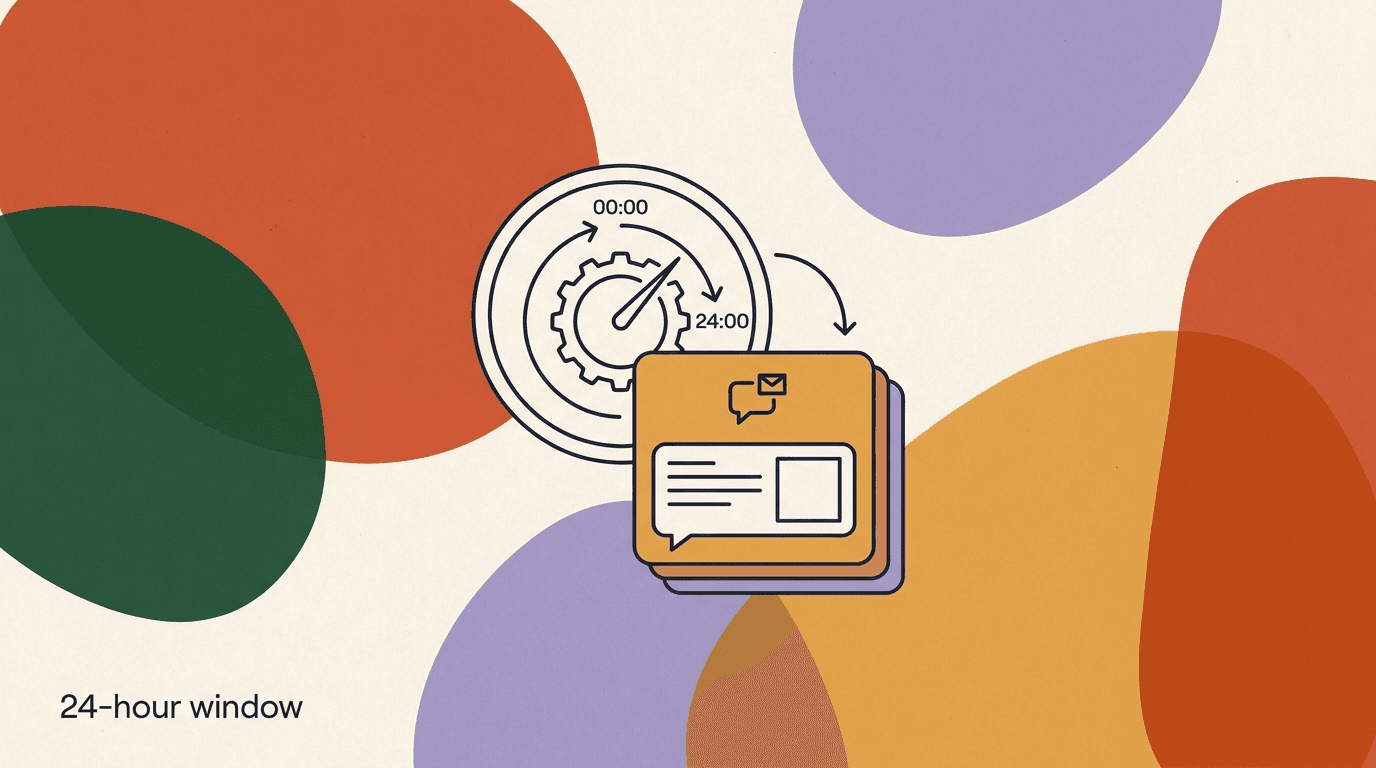
The core principle running through the policy is consent and timing. Automated messaging is permitted, but it is structured around the idea that you are responding to people who have interacted with you, not broadcasting to strangers. The platform enforces this partly through the 24-hour standard messaging window, which limits when you can send standard messages after a user's last interaction. Sending within that window in response to genuine engagement is exactly what the API is built for; trying to route around it to reach cold audiences is where policy problems begin.
The other half is that Meta reserves the right to limit reach or take enforcement action on accounts that break the Community Guidelines or behave abusively, and it documents its approach to enforcement publicly in its transparency materials. That is the honest backdrop for any automation decision: following the messaging policy dramatically lowers your risk, but the platform's rules and enforcement are Meta's to set and change. We link the primary policy sources at the end of this article so you can verify the current wording yourself rather than relying on a secondhand paraphrase.
One more thing about reading the policy directly: it is written for developers, but the parts that matter to you are plain enough. The recurring themes are consent, timing, and honesty about who you are and what you are sending. If a proposed use of automation would be hard to explain to a user as something they agreed to and expected, that is usually a sign it sits outside what the policy intends — long before you ever hit a technical limit. Treat that gut check as a first-pass filter, then confirm the specifics against the published rules.
Read the primary sources, not the sales pages
Any tool can claim it is safe. The policy that actually governs your account is Meta's, and it is published. Skim the messaging platform policy and Instagram's help center before you commit to any automation approach, and re-check them periodically because the rules do get updated.
How does the official Meta Messaging API keep automation compliant?
The official API is not just a technically approved channel — it is engineered to make compliant behavior the default and non-compliant behavior difficult. That is the real reason official-API automation carries so much less risk than a bot: many of the mistakes that get accounts restricted are simply not possible through the sanctioned interface, because the guardrails are built into the system rather than left to your good intentions.
The most important guardrail is that the API is consent-shaped. It is designed around conversations that a user initiated — a comment, a story reply, a DM, a click on an ad that opens a chat. You respond to people who reached out, which is precisely the pattern Instagram wants to see. The 24-hour window is enforced by the platform, so the system itself stops you from drifting into cold, out-of-window broadcasting. You do not have to remember the rule; the API holds the line.
Rate limits are the second built-in protection. The API caps how fast and how much you can send, which makes the machine-gun send pattern of a growth-hack bot structurally impossible. And because access is through an authorized connection rather than your password, the platform can always see that the traffic is a known, reviewed API client operating within bounds — not a mystery login from a server pretending to be you. Combine consent-shaped conversations, an enforced window, real rate limits, and authorized access, and you have removed most of the levers that cause restrictions in the first place.
- Authorized connection — no password handed to the tool.
- Consent-shaped: you reply to people who contacted you first.
- The 24-hour messaging window is enforced by the platform.
- Rate limits make machine-gun sending structurally impossible.
- Traffic is identifiable as a reviewed API client, not a mystery login.
What are the warning signs your account is shadowbanned or restricted?
Before you assume the worst, it helps to know what a genuine restriction actually looks like versus ordinary algorithm noise. The clearest signals are the ones you can check directly rather than infer from a bad week. Instagram now surfaces a lot of this through its Account Status and support-request tools, which tell you whether your content or account is currently limited and why.
The most reliable indicator is a formal notice in Account Status: a message that a post was removed, that your account is not eligible to be recommended, or that specific content does not follow the guidelines. That is the closest thing to an official confirmation you will get, and it usually comes with a reason and, often, a way to request a review. If Account Status is clean, you are probably looking at normal variance rather than an enforcement action.
Softer signals are worth watching but easy to misread. A sudden, sustained drop in reach specifically from non-followers — hashtags, Explore, recommendations — while your existing followers still see you normally can point to reach limiting. So can your posts no longer appearing under hashtags you use when you check from a logged-out account. The trap is over-reading a single quiet week; look for a persistent pattern across multiple posts, and always cross-check against Account Status before concluding anything.
| Signal | Likely a restriction? | What to check |
|---|---|---|
| Account Status shows a limit or removal | Yes — this is official | Read the reason, request review if offered |
| Reach from non-followers drops sharply and stays down | Possibly | Compare several posts over weeks, not one |
| Posts vanish from hashtag results (logged out) | Possibly | Test from a second, logged-out session |
| One post underperformed this week | Usually not | Normal variance — wait and watch |
| An action block message when you like or follow | Yes — a temporary block | Stop the action, wait it out, review behavior |
Check Account Status before you panic
Instagram's Account Status and support-request tools are the authoritative place to see whether your account or a post is actually limited, and why. Diagnose there first. A lot of suspected shadowbans turn out to be ordinary reach volatility that resolves on its own.
How do you keep DM automation safe?
Staying safe is less about secret tricks and more about picking the right method and then behaving reasonably within it. If you get the foundational choice right — official API over gray-market bot — most of the remaining risk takes care of itself. The steps below are the practical checklist we would give anyone setting up Instagram automation for the first time.
None of this guarantees you will never see an enforcement action, and we will not pretend otherwise. But following these steps puts you firmly inside the sanctioned, consent-based lane that the platform is built to allow, which is the single biggest thing within your control.
- Use official-API tools onlyConfirm the tool connects through Meta's authorized flow and never asks for your Instagram password. If it wants your login credentials, walk away.
- Automate replies, not cold outreachTrigger automation from real engagement — comments, story replies, DMs, ad clicks. Do not use it to message people who never interacted with you.
- Respect the 24-hour windowSend standard messages inside the window after a user's last interaction. Do not try to route around it to reach cold or lapsed audiences.
- Vary your copy and keep it humanAvoid firing identical text at everyone. Personalize where you can, and keep messages genuinely helpful rather than a repeated pitch.
- Warm up new accounts graduallyA brand-new account behaving like a high-volume sender on day one looks suspicious. Ramp activity up over time rather than starting at full throttle.
- Watch Account Status and adjustCheck your Account Status periodically. If Instagram flags anything, slow down, fix the behavior it names, and request a review where offered.
The safest automation feels like good service
A useful rule of thumb: if your automation is answering people who reached out to you, quickly and helpfully, you are almost certainly fine. If it is chasing people who never asked to hear from you, you are in the risky lane no matter what tool sent it.
What sending behaviors raise your automation risk?
It helps to be concrete about which specific behaviors move the needle on risk, because not all automation is equally exposed. Two accounts can both use automation and have wildly different odds of a restriction depending on what, and how, they send. The table below sorts common behaviors from low risk to high risk so you can locate your own setup on the spectrum.
Read this as a gradient, not a set of hard lines. The far-left column is what the API is designed for and what the platform wants to see. The far-right column is what growth-hack bots do and what detection systems hunt for. Most legitimate businesses live comfortably on the left; the trouble starts when people drift rightward chasing volume.
- Consent is the axis that matters most: did the person interact with you first?
- Volume and repetition amplify risk — the same message to many people fast is the spam signature.
- Timing matters: staying inside the 24-hour window keeps you in the sanctioned lane.
- Method sits underneath all of it: an official API on the left, a password-login bot on the right.
| Behavior | Risk level | Why |
|---|---|---|
| Auto-reply to a DM someone sent you | Low | Pure consent — the user started it |
| Comment-to-DM on your own post, within policy | Low | The user opted in by commenting |
| Broadcast to opted-in contacts within the window | Low to moderate | Consent exists; timing and frequency matter |
| Templated message to every new follower | Moderate to high | Low consent, repetitive, high volume |
| Cold DMs to non-followers | High | Unsolicited outreach — classic spam signal |
| Bot logins doing follow/unfollow loops | Very high | Off-API, inhuman pattern, terms violation |
What is the 24-hour messaging window and why does it matter?
The 24-hour window is one of the most important pieces of the compliance puzzle, and it is worth understanding because so much safe-versus-risky behavior comes down to it. In simple terms, when a user interacts with your account — sends a message, replies to a story, comments in a way that opens a conversation — Meta's messaging policy gives you a window, generally 24 hours, in which you can send standard messages back to them. Outside that window, the rules for what you can send tighten considerably.
This design is not an obstacle; it is the mechanism that keeps automation consent-based. Because your ability to send standard messages is tied to a recent interaction the user initiated, the window structurally prevents the cold, out-of-nowhere broadcasting that gets accounts flagged. If someone just messaged you, replying with automation is exactly what the system expects. If you are trying to message someone who has not interacted in weeks, the window is telling you something: that conversation is not the kind the platform wants automated.
The practical implication is that good automation is built around timely responses to fresh engagement, and any tool worth using enforces the window for you rather than leaving you to track it. Attempts to route around the window — to reach cold or long-lapsed audiences with standard messages — are precisely where policy risk concentrates. We go deeper on the mechanics and edge cases in our explainer on the Instagram 24-hour messaging window, which is worth reading if you plan to run broadcasts.
The window is a feature, not a limitation
It is tempting to see the 24-hour window as a restriction on your reach. It is better understood as the guardrail that keeps your automation on the right side of policy. Respecting it is a large part of what separates compliant messaging from the patterns that get restricted.
How do you recover from a shadowban or restriction?
If you already suspect a restriction, the good news is that many of them are recoverable, especially the softer reach-limiting kind. Recovery is less about a magic reset and more about identifying the cause, stopping it, and giving the platform time to re-evaluate. The steps below are the sensible sequence; there is no guaranteed timeline, and we will be honest that some outcomes are Meta's call rather than yours.
Before anything else, confirm you are actually dealing with an enforcement action rather than ordinary variance, using the diagnostic signs from earlier. Recovering from a shadowban that never happened just means waiting out a normal quiet week. Once you have confirmed a real limit in Account Status, work through the following.
- Read Account Status for the specific reasonFind out exactly what Instagram flagged — a removed post, a content-guideline issue, an action block. The stated reason is your starting point.
- Stop the behavior that triggered itIf a gray-market bot was operating your account, disconnect it immediately. If cold DMs or high-volume sending was the cause, halt it entirely.
- Remove or fix flagged contentDelete or edit anything Account Status identifies as violating the guidelines. Leaving flagged content up prolongs the limit.
- Request a review where offeredIf Instagram provides a way to request a review of a removal or limit, use it. This is the sanctioned appeal path.
- Pause and behave normally for a whileGive the account a quiet period of ordinary, human activity. Do not immediately resume aggressive sending — that risks compounding the problem.
- Rebuild automation the compliant wayWhen you re-introduce automation, switch to an official-API tool and reply-based triggers so the pattern that caused the restriction cannot recur.
No one can guarantee a recovery timeline
Anyone promising a definite date by which your reach will return, or a service that guarantees to lift a shadowban, is selling certainty they do not have. Enforcement and reinstatement are Meta's decisions. Do the recoverable things, then be patient.
Myth versus reality: common shadowban claims examined
The shadowban topic attracts a lot of confident claims, and many of them are wrong or half-right in ways that lead people to make bad decisions. Since this whole article is a myth-versus-reality exercise, it is worth putting the most common claims side by side with what actually holds up. The table sorts frequent beliefs into the parts that are true and the parts that are not.
The pattern across all of these is the same: the myths blame the tool or invent a mechanical rule, while the reality points back to method and behavior. Once you internalize that, most shadowban folklore stops being scary and starts being easy to evaluate.
| Common claim | Reality |
|---|---|
| Any DM automation causes a shadowban | False — official-API, reply-based automation is compliant |
| Using too many hashtags triggers a ban | Mostly myth — irrelevant or off-topic tags can hurt reach, but it is not the automation issue people think |
| A bot that has worked for months is proven safe | False — detection is delayed and probabilistic; a quiet period is not proof |
| Shadowbans are permanent | Usually false — soft reach limits often recover once the cause is fixed |
| A paid service can guarantee a shadowban is lifted | False — reinstatement is Meta's decision, not a vendor's |
| Official API tools have zero risk | Overstated — much lower risk, but no tool can guarantee against Meta enforcement |
When you hear a shadowban claim, ask about method
The fastest way to test any shadowban advice is to ask whether it is really about the sending method and behavior, or about the tool as a category. If someone blames automation itself rather than the pattern behind it, they have the diagnosis backwards.
How does KlyoChat approach automation risk?
We built KlyoChat on the compliant side of every distinction in this article, and we want to be precise about what that does and does not mean. KlyoChat is an AI-native unified inbox that brings Facebook, Instagram, WhatsApp, Telegram, TikTok, and X into one place, then adds no-code automation, comment-to-DM funnels, and custom AI agents on top. Every bit of the Instagram and Facebook messaging it does runs on the official Meta Messaging API — never a gray-market bot, never your password, never a login that simulates a human. That single architectural choice is what puts our automation in the sanctioned lane rather than the risky one.
In practice that means the guardrails from earlier in this piece are baked into the product. Automation is triggered by real engagement — a comment, a DM, a story reply — rather than cold outreach. The comment-to-DM feature operates within Meta's policy. Our AI agents answer people who contacted you first, and the platform's 24-hour window and rate limits apply to us exactly as they apply to any authorized API client, because that is what we are. You can read more about how the assistants work on our AI agents page.
Here is the honest limit, stated plainly: using an official-API tool like KlyoChat meaningfully lowers your risk, but it cannot guarantee that Meta will never take action on your account. No tool can, and anyone who claims otherwise is not being straight with you. What we can promise is the method — compliant, authorized, consent-based — and the guardrails around it. We are also candid about the rest of the picture: KlyoChat does not do native SMS or email, and we are a newer product with a smaller community than the incumbents. If those tradeoffs matter to you, weigh them.
- Official Meta Messaging API for Instagram and Facebook — no gray-market bots.
- Automation triggered by real engagement, not cold DMs.
- Comment-to-DM within policy; AI agents answer people who reached out first.
- Pricing is flat: Basic $19, Pro $49 ($39 billed yearly), Business $129, with a 7-day trial and no credit card. See the full plans on our pricing page.
- Honest limits: no native SMS or email, a newer and smaller community, and no guarantee against Meta enforcement.
Compliant by architecture, honest about the ceiling
The most useful thing a tool can do about shadowban risk is remove the risky mechanics entirely — no password logins, no cold-outreach patterns, no routing around the window. KlyoChat does that. What it cannot do, and does not claim, is override Meta's right to enforce its own rules.
What KlyoChat commits to — and what it does not
- We commit to
- Official Meta Messaging API only, no password logins, consent-based reply automation
- We do not promise
- That Meta will never restrict an account — no tool can guarantee that
The honest conclusion on instagram shadowban automation is calmer than the fear around it suggests. Automation is not the villain; the method and the behavior are. Gray-market bots that log into your account, mass unsolicited DMs, repetitive high-volume sending, and content that breaks the guidelines are what trigger Instagram account restrictions. Official-API automation that answers people who contacted you first and respects the 24-hour window sits in the lane the platform built to allow — lower risk by design, though never a guarantee against Meta's own enforcement.
So the practical move is simple: pick the compliant method, behave like a helpful business rather than a spammer, diagnose real problems through Account Status instead of folklore, and keep your expectations honest. If you want to go deeper on the surrounding topics, our guide to running Instagram automation safely covers the foundations, the piece on common DM automation mistakes shows the specific patterns to avoid, and the 24-hour window explainer unpacks the timing rule that so much of this depends on. Read Meta's own messaging policy alongside them, and you will be equipped to make a good decision rather than a fearful one.