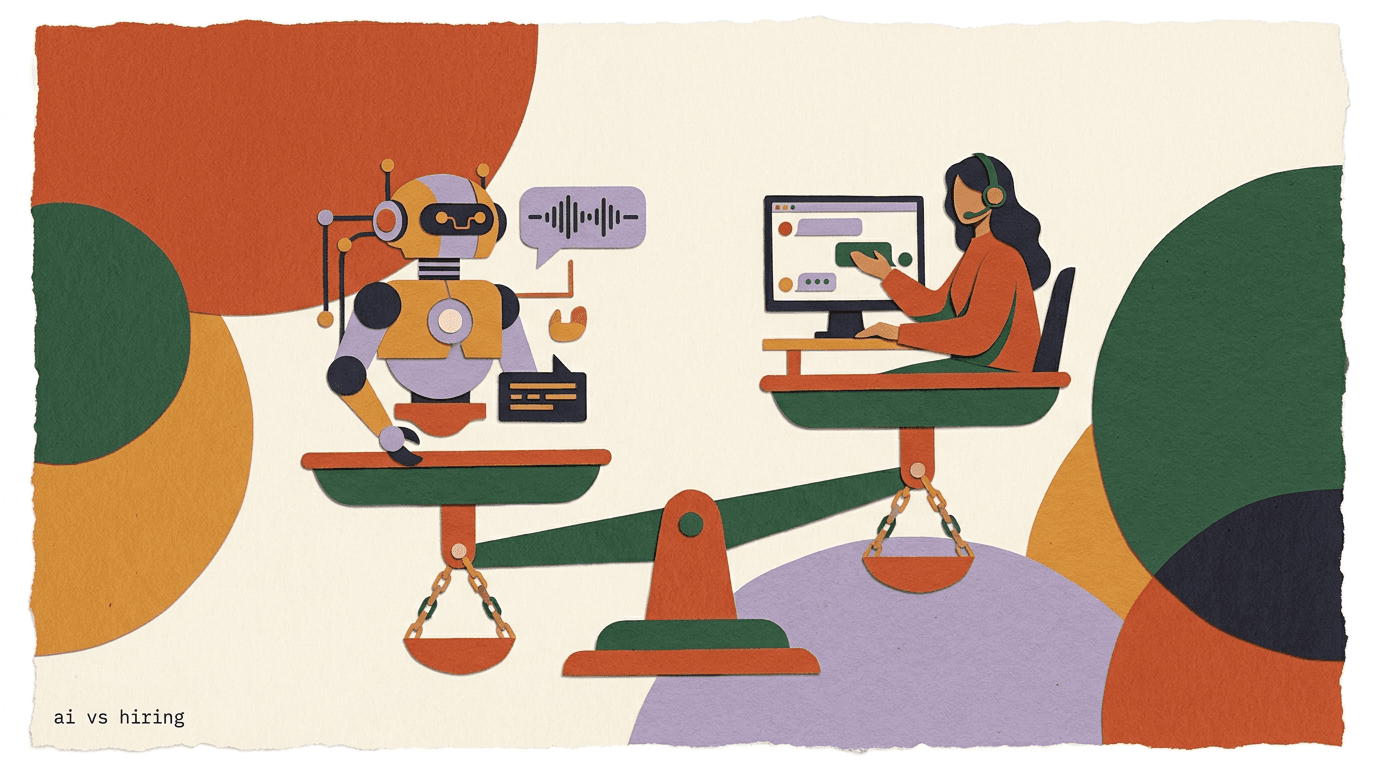
The decision of AI agents vs hiring support staff rarely comes down to one clean number, which is exactly why it feels harder than it should. On paper, an AI agent looks cheaper and a human looks safer, and both of those instincts are partly right and partly wrong. The honest answer depends on what your conversations actually look like, how they arrive, how much they vary, and how much a bad reply costs you when it happens.
This guide is a balanced trade-off, not a sales pitch for replacing your team. We build KlyoChat, so we have a point of view, and we will be plain about where AI helps and where it does not. The short version we keep coming back to with customers is simple: AI augments good people, it does not replace them. Used well, it removes the repetitive volume that burns support staff out and frees the humans you hire to do the work only humans can do.
We will walk through what each option really costs, how they compare on quality, scalability, empathy, coverage, and ramp time, and then give you a decision framework you can apply to your own volume. Every cost figure here is either a framework you fill in with your own numbers or a clearly-labelled illustrative example. We are not going to invent salary data or pretend a spreadsheet can settle a hiring decision on its own.
What is the real trade-off between AI agents and hiring support staff?
The real trade-off is not cost versus quality, even though that is how it usually gets framed. It is consistency and volume on one side against judgment and relationship on the other. An AI agent gives you the same answer at two in the afternoon and two in the morning, to the first customer and the ten-thousandth, without getting tired or distracted. A skilled human gives you an answer that bends to context, reads emotion, takes ownership of a mess, and remembers that this particular customer has had a rough week.
Those are different strengths, and the mistake is treating them as substitutes competing for the same job. Most support queues are a blend of two very different kinds of work. There is the repetitive tier, the where-is-my-order and how-do-I-reset-my-password questions that arrive in huge volume and have known answers. Then there is the judgment tier, the refund disputes, the confused-and-upset messages, the edge cases no script anticipated. AI is very good at the first and mediocre at the second. People are wasted on the first and essential for the second.
So the sharper question is not whether to choose AI or humans. It is how to split your queue so each kind of work goes to whichever is genuinely better at it. That reframing is the whole point of this article, and it is also why the strongest teams end up blending rather than picking a side. If you want the underlying financial argument in more depth, we lay it out in the business case for AI agents.
Substitutes or teammates?
The framing that leads teams astray is 'AI instead of people.' The framing that works is 'AI for the repetitive tier, people for the judgment tier, and clean handoff between them.' Almost everything in this guide follows from that distinction.
What does hiring a support person actually cost?
Hiring is more expensive than the salary line, and undercounting the extras is the most common budgeting error teams make. The wage is only the visible part. On top of it sit payroll taxes, benefits, equipment, software seats, and the management time it takes to keep a person supported and growing. There is also the cost of hiring itself: the job posts, the interviews, the hours your existing team spends screening instead of answering tickets.
Then there is ramp. A new support hire is not fully productive on day one, or day thirty. They need to learn your product, your tone, your policies, and the hundred small exceptions that live in nobody's documentation. During that period you are paying full cost for partial output, and someone senior is spending time coaching rather than doing their own work. None of this is a reason not to hire. It is a reason to count the whole number honestly instead of the wage alone.
Because the true figures vary so much by region, seniority, and industry, we will not print salary numbers and pretend they are universal. Instead, here is the framework. Add up every component below for your own situation, and you will have a defensible fully-loaded cost per support person rather than a wage that understates reality by a wide margin.
- Base wage or salary for the role at your level and location.
- Payroll taxes, benefits, and any statutory contributions.
- Equipment, tooling, and per-seat software licenses.
- Recruiting cost: advertising, interviewing time, and any agency fees.
- Onboarding and ramp: reduced output plus a senior person's coaching time for the first weeks or months.
- Ongoing management: one-to-ones, scheduling, quality review, and retention effort.
- Turnover risk: when someone leaves, you pay the recruiting and ramp costs again.
Do not compare a wage to a subscription
The unfair comparison is a support agent's monthly salary against an AI tool's monthly fee. The fair comparison is the fully-loaded cost of a person, including taxes, benefits, ramp, and management, against the fully-loaded cost of automation, including setup and oversight. Compare loaded totals to loaded totals or the numbers will mislead you.
What does deploying AI agents actually cost?
AI agents have their own hidden costs, and pretending they are free is as dishonest as pretending humans are cheap. The subscription is the obvious line. Underneath it sit the costs of setup and maintenance: someone has to write the knowledge base the agent draws on, define what it is allowed to say, connect it to your channels, and keep it current as your product and policies change. An agent trained on last quarter's return policy will confidently give this quarter's customers the wrong answer.
There is also the cost of oversight. A responsible AI deployment is not fire-and-forget. Someone reviews a sample of conversations, watches for cases where the agent guessed instead of deferring, and tunes the handoff rules so hard questions reach a person quickly. This is real work, though it is a fraction of what it would take to answer that same volume by hand. The point is that the effective cost of AI is the subscription plus the human hours around it, not the subscription alone.
The upside is how those costs behave as volume grows. A human's capacity is roughly fixed, so double the tickets and you need roughly double the people. An AI agent's cost per additional conversation is low and often flat within a plan, so doubling volume changes the bill far less. We go deep on that unit economics in AI agent cost per conversation, and you can see how KlyoChat structures the underlying pricing on a flat plan rather than metering every message.
- Subscription or platform fee for the AI agent and inbox.
- Initial setup: writing the knowledge base, defining guardrails, connecting channels.
- Ongoing maintenance: keeping answers current as products and policies change.
- Oversight: sampling conversations, tuning handoff rules, catching bad answers.
- Any per-message or per-reply metering, if your vendor charges that way.
AI has a floor of human effort, not zero
The realistic cost of an AI agent is the software plus the person who trains and supervises it. That total is usually well below the cost of staffing the same volume manually, but it is never zero. Budget for the oversight or the quality will drift.
How do AI agents and human support staff compare, side by side?
Rather than argue in the abstract, it helps to line the two up across the dimensions that actually decide the outcome. The table below is a qualitative comparison, not a scoreboard, and the right-hand column is the one most teams underrate: a blended team tends to inherit the better half of each column rather than the worse half of either.
Read it as a map of strengths, not a verdict. No single row settles the decision. The mix that is right for you depends on which rows matter most for your particular business, which is exactly what the decision framework later in this guide is for.
| Dimension | Human support staff | AI agents | Blended team |
|---|---|---|---|
| Cost per conversation at high volume | Rises with headcount | Low and often flat within a plan | Low on routine, human cost reserved for complex |
| Consistency of answers | Varies by person and mood | Highly consistent | Consistent on routine, judged on complex |
| Handling ambiguity and edge cases | Strong | Weak to moderate | Strong, because ambiguity is routed to people |
| Empathy in sensitive moments | Strong | Limited and can feel hollow | Strong, because sensitive cases reach a person |
| Coverage outside business hours | Expensive to staff | Continuous | Continuous first response, human follow-up |
| Speed of first response | Depends on queue and load | Immediate | Immediate, with human depth when needed |
| Ramp time to productivity | Weeks to months per hire | Days to configure | Fast on routine, invests ramp only in senior roles |
| Scales with volume spikes | Poorly without over-hiring | Absorbs spikes easily | Absorbs spikes, escalates the hard subset |
Weight the rows that match your business
A high-volume store with simple questions should weight cost, consistency, and coverage heavily. A financial or health service should weight empathy, ambiguity, and accountability. The same table points to different answers depending on what you sell and to whom.
Which scales better as your conversation volume grows?
Scalability is where the two options diverge most sharply, and it is the reason AI entered support in the first place. Human capacity is close to linear. If one person comfortably handles a certain number of conversations a day, then handling ten times that many means hiring roughly ten times the people, plus the managers to lead them, plus the space and tooling to support them. Growth in demand becomes growth in headcount, and headcount is slow to add and painful to remove.
AI agents scale differently. The same configured agent can hold one conversation or a thousand at once without a proportional increase in cost or any drop in speed. When a post goes viral, a sale launches, or an outage floods your inbox, an AI agent absorbs the surge and gives every customer an instant first response. A human team facing that same spike either makes everyone wait or was over-staffed for the quiet weeks in order to survive the busy ones.
This is the clearest case for automation, and it is genuinely strong. But notice what it does not say. It does not say AI answers those thousand conversations well, only that it answers them fast and cheaply. Volume without quality is a liability, not an asset. The scalability argument is powerful precisely when the surging volume is the repetitive kind, and much weaker when a spike is full of angry, complicated, high-stakes messages that each need a person.
Illustrative scenario: a flash sale spike (placeholder numbers)
- Setup
- A store runs a one-day sale; inbound messages jump roughly tenfold for 24 hours
- Human-only team
- Queue backs up, first-response time stretches to hours, overtime or temps needed
- AI-first with handoff
- Every customer gets an instant answer to routine questions; only disputes and exceptions wait for a person
- Takeaway
- AI shines when the spike is mostly repetitive; the human subset still needs staffing
What about empathy, tone, and the human touch?
This is where honesty matters most, because it is where the automation industry tends to overpromise. AI can be polite, warm in wording, and fast, and for a routine question that is plenty. What it cannot reliably do is feel what the customer is feeling and respond from genuine care. When someone is frightened about a charge they do not recognize, grieving, furious about a repeated failure, or trusting you with something that matters to them, a competent human presence is worth more than any perfectly phrased automated reply.
Customers can also tell the difference in moments that count. An empathetic-sounding sentence generated by software can land as hollow, even irritating, when the person on the other end is in real distress and wants to be heard by someone who can actually do something. Pushing AI into those conversations to save money is a false economy. It protects the budget and damages the relationship, and relationships are usually the more expensive thing to lose.
So the empathy question does not favor humans everywhere. It favors humans in the specific moments that carry emotional or financial weight. The design goal is to make sure those moments reach a person quickly and cleanly, while letting AI carry the large majority of interactions that are transactional and unemotional. That is not a compromise; it is putting each kind of care where it belongs. The broader picture of how these roles are shifting is something we cover in the future of support work.
The false economy of automated empathy
Using AI to handle emotionally charged or high-stakes conversations to cut costs is the fastest way to erode trust. Route those to a human every time. The savings are small and the reputational damage is not.
How does coverage differ across hours, languages, and channels?
Coverage is a quieter advantage of AI, and for many small teams it is the one that tips the decision. Customers message when it suits them, which is evenings, weekends, and the middle of the night, across time zones you may not staff. Providing genuine round-the-clock human coverage means multiple shifts or a distributed team, which is expensive and hard to justify when the after-hours volume is low but not zero. An AI agent covers those gaps by default, answering instantly whether or not anyone is at a desk.
The same is true across languages and channels. A human who speaks three languages is rare and costly; an AI agent can respond in many. A small team stretched across Instagram, WhatsApp, Facebook, Telegram, TikTok, and more can miss messages simply because nobody is watching every channel at once. AI does not have that attention limit. It watches every connected channel continuously and gives a consistent first response wherever the customer chose to reach you. The general shape of always-on service is part of what modern customer support has come to mean.
Coverage is a strong, real argument for AI, with one honest caveat. Being available is not the same as being helpful. Twenty-four-hour availability is only valuable if the answers are correct and the hard cases are flagged for a person to pick up when they are back. Round-the-clock wrong answers are worse than an honest away message. The value of coverage depends entirely on pairing instant availability with reliable escalation.
- After-hours and weekend coverage without staffing extra shifts.
- Multiple languages without hiring for each one.
- Every connected channel watched at once, so nothing sits unseen.
- Instant first response regardless of where or when the customer messages.
- The essential caveat: availability only helps if answers are correct and escalation is reliable.
How long until each option is actually productive?
Ramp time is often left out of the comparison, and it changes the picture more than people expect. A human hire takes real time to become effective. They learn the product, absorb the tone, memorize the exceptions, and build the judgment that separates a good support answer from a technically-correct-but-unhelpful one. During that stretch you pay full cost for partial output, and a senior teammate spends hours coaching. If the person leaves, you start the clock again with the next hire.
Configuring an AI agent is faster to stand up but front-loads a different kind of work. You are not waiting for a person to learn; you are doing the teaching up front by writing the knowledge base and setting the guardrails. Done properly, an agent can be handling real conversations within days rather than weeks. The trade is that the quality of its answers is capped by the quality of what you gave it. A thin knowledge base yields a thin agent, no matter how capable the underlying model is.
Neither ramp is free, then, but they fail differently. A weak human hire can still improvise around gaps in their training using common sense. A weak AI setup cannot; it will answer confidently from whatever it was given, gaps and all. That difference is a good argument for investing seriously in the initial configuration and for keeping a human in the loop while the agent proves itself, rather than switching it on and walking away.
- Human hire rampWeeks to months. Learns product, tone, and exceptions on the job, with senior coaching time as an ongoing cost until fully productive.
- AI agent rampDays to configure, but the answer quality is capped by the knowledge base and guardrails you provide up front. Thin input, thin output.
Where do AI agents genuinely fall short today?
A balanced comparison has to name the limits plainly, because a tool oversold is a tool that disappoints. AI agents still struggle with true ambiguity, with situations that require weighing competing values rather than retrieving a known answer, and with anything where being confidently wrong is costly. They can hallucinate, which is a polite word for stating something false as if it were fact. They do not truly understand the way a person does; they pattern-match extremely well, and the gap between those two things shows up exactly in the cases you care about most.
They also lack accountability in the human sense. When a person makes a judgment call and owns the outcome, that ownership is part of good service. An agent cannot take responsibility, apologize with sincerity that lands, or decide to bend a policy because this specific situation clearly warrants it. For sensitive categories such as health, money, legal matters, safety, and anything involving a vulnerable customer, those gaps are not edge cases. They are the main event, and they are reasons to keep a person firmly in the loop.
None of this argues against using AI. It argues for using it where its strengths are decisive and its weaknesses are cheap, and for designing an escalation path so its weaknesses are contained. The teams that get the most from automation are the ones most clear-eyed about what it cannot do. The general field of artificial intelligence has advanced quickly, but confident output is not the same as correct judgment, and treating it as such is where deployments go wrong.
Keep humans on sensitive categories
For health, money, legal, safety, and vulnerable-customer situations, keep a person in the loop by default. Use AI to triage and gather context if you like, but let a human make the call and own the outcome. This is a policy choice, not a technical limitation you can configure away.
When should you hire support staff instead of automating?
There are clear situations where a hire is the better move, and it is worth naming them so automation does not become a reflex. If most of your conversations are genuinely complex, unique, or emotionally weighted, a person is the right answer for the bulk of them, not the exception. Consultative sales, specialist technical support, regulated services, and premium or high-touch brands all live in this territory. In those settings the human relationship is the product, and thinning it to save money quietly damages the thing customers are paying for.
You should also lean toward hiring when the cost of a wrong answer is high. If a mistaken reply can trigger a refund, a compliance problem, a safety issue, or a lost long-term account, the economics flip. The money you would save by automating that conversation is small next to the money one bad automated answer can cost. Low volume is another signal: if you only field a handful of conversations a day, the setup and oversight effort of a well-run AI deployment may not pay back, and a capable human simply handling them is the simpler choice.
Finally, hire when your differentiation is service itself. Some brands win specifically because a real, knowledgeable person answers, remembers you, and takes care of things. If that is your edge, protect it. Automation can still help those teams behind the scenes by drafting, summarizing, and handling the truly routine overflow, but the front line stays human on purpose.
- Most conversations are complex, unique, or emotionally weighted.
- The cost of a wrong answer is high: refunds, compliance, safety, or lost accounts.
- Volume is low enough that setup and oversight outweigh the savings.
- Service quality is your differentiation and the human relationship is the product.
- You operate in a regulated field where accountability must sit with a person.
When do AI agents make more sense than a new hire?
The mirror image is just as clear. When a large share of your volume is repetitive, predictable, and answerable from known information, AI is the better first responder. Order status, shipping questions, password resets, hours and location, return policy, basic product facts: these are high-frequency, low-variance questions with correct answers that do not change often. Paying a person to type the same reply hundreds of times is not just expensive, it is a reliable way to burn out the person doing it.
AI also makes sense when you need coverage you cannot staff, when volume is spiky and unpredictable, and when speed of first response is itself a competitive edge. A customer who gets an instant, correct answer at midnight is better served than one who waits until morning for a person to say the same thing. In all of these cases the pattern is the same: the work is high-volume and low-judgment, which is precisely the quadrant where automation is strong and human time is wasted.
There is a quieter benefit worth naming, because it is about your people, not just your budget. When AI takes the repetitive tier, the humans you employ spend their day on the interesting, difficult, human work instead of grinding through the same five questions. That tends to raise the quality of their answers and lower the odds they quit. Automation applied well is not only a cost story; it is a retention and morale story too. Broadly, this is what thoughtful automation is for: removing the repetitive load so human effort lands where it matters.
Illustrative split of a support queue (placeholder proportions)
- Repetitive tier
- Order status, resets, hours, policy questions — high volume, known answers → AI first
- Judgment tier
- Disputes, upset customers, edge cases, high-stakes decisions → human, with AI context
- The insight
- The right question is not AI or human, but what share of your queue is each
Why is blending AI agents and humans usually the right answer?
By now the pattern should be obvious: the two options are strong in opposite places, which is the textbook condition for combining them rather than choosing. A blended model lets AI take the repetitive volume it handles well and cheaply, while people take the complex and sensitive work they handle better. Each does what it is genuinely good at, and neither is stretched into the territory where it fails. The whole is more capable than either part alone, and usually cheaper than an all-human team while being warmer than an all-AI one.
The mechanics of blending come down to routing and handoff. AI answers first, resolves what it can, and recognizes when a conversation is beyond it, then passes it to a person with the full context attached so the customer never has to repeat themselves. The human picks up warm, not cold. Behind the scenes, AI can keep helping even on the human tier by drafting replies, summarizing long threads, and surfacing the relevant policy, so your people move faster without losing the human judgment that made the handoff worthwhile.
Done this way, automation is not a threat to your team; it is leverage for it. You are not deciding between paying for people and paying for software. You are deciding how to combine them so that a smaller, happier human team supported by capable AI outperforms a larger team drowning in repetitive tickets. That is the shape most successful support operations are converging on, and it is the honest recommendation of this article.
- Let AI answer firstThe agent handles routine questions instantly across every channel, resolving the large, low-judgment share of your queue on its own.
- Detect the limitSet rules and let the agent recognize complex, sensitive, or high-stakes conversations it should not attempt to close alone.
- Hand off with contextPass those conversations to a person with the full history and a summary attached, so the customer never repeats themselves.
- Support the human tierUse AI to draft, summarize, and surface policy for your people, so they move faster on the hard cases without losing judgment.
- Review and tuneSample conversations regularly, correct where the agent guessed, and adjust the handoff rules as your product and volume change.
The blend beats either extreme
All-human is warm but expensive and hard to scale. All-AI is cheap and always on but shallow on the cases that matter. The blend takes the better half of each: cheap consistent coverage on the routine, human judgment on the complex.
How do you decide your own mix? A practical framework
Instead of a verdict, here is a framework you can run against your own numbers in an afternoon. The goal is not to reach a single right answer but to size the two tiers of your queue honestly, price each option at your real fully-loaded cost, and choose the mix that fits. Work through the steps below, then use the decision matrix to sanity-check where you land.
The illustrative example that follows uses placeholder numbers so you can see the shape of the calculation. Do not treat the figures as market data. Replace every one of them with your own wage, tax, and volume numbers, because those vary enormously by region, seniority, and industry, and the whole point is to make the decision on your reality rather than someone else's averages.
- Measure your queue splitFor a representative week, tag conversations as routine or judgment. The ratio is the single most important input to the decision.
- Price a fully-loaded hireAdd wage, taxes, benefits, tooling, recruiting, ramp, and management for your role and region. This is your true cost per person.
- Price a supervised AI deploymentAdd the subscription, setup effort, and the ongoing oversight hours. This is your true cost of automation, not the sticker alone.
- Estimate quality riskFor your judgment tier, estimate the cost of a wrong answer. High-stakes queues justify more human coverage; low-stakes queues justify more automation.
- Choose the mix and set the handoffAssign the routine tier to AI, the judgment tier to people, and define the escalation rules between them. Revisit as volume grows.
| Cost component | Human hire (illustrative) | AI agents (illustrative) |
|---|---|---|
| Direct cost | Fully-loaded wage: your number here | Subscription: your plan here |
| Setup / ramp | Weeks of reduced output plus coaching | Days of knowledge-base and guardrail work |
| Ongoing effort | Management, scheduling, retention | Oversight and knowledge-base upkeep |
| Scales with volume | Add roughly one person per capacity unit | Low added cost per extra conversation |
| Best used for | Complex, sensitive, high-stakes work | Repetitive, high-volume, known-answer work |
These numbers are illustrative, not data
The table shows the shape of the comparison, not real prices. Fill every cell with your own figures. A precise-looking number you did not verify is more dangerous than an honest blank you fill in yourself.
Which mix fits your situation? A decision matrix
To make the framework concrete, here is a matrix that maps common situations to a starting recommendation. It is a starting point, not a rule. Your queue split and your quality risk can override any single row, and most real businesses recognize themselves in more than one line at once.
Read across from the situation that best describes you to the lean and the reason. If two rows apply, weight the one tied to higher stakes. When in doubt, start blended and let the data from your first weeks pull the mix in one direction or the other.
| Your situation | Lean toward | Why |
|---|---|---|
| High volume, mostly routine questions | AI-first with handoff | Automation absorbs the repetitive load cheaply; people take the exceptions |
| Low volume, mostly complex cases | Hire | Setup and oversight rarely pay back at low volume with high judgment |
| Spiky, unpredictable volume | AI-first with handoff | AI absorbs surges without over-hiring for the quiet periods |
| High-stakes or regulated conversations | Human-led, AI assist | Accountability and judgment must sit with a person; AI supports behind the scenes |
| Service quality is your differentiation | Human-led, AI assist | The relationship is the product; automate only the invisible overflow |
| Growing team, rising repetitive load | Blend | Automate the routine to protect morale and headroom; hire for the hard tier |
| After-hours or multilingual gaps | AI for coverage, human follow-up | Instant first response fills gaps you cannot affordably staff |
When unsure, start blended
If your situation is mixed, default to AI on the routine tier with a clean handoff to a person on the complex tier. The first few weeks of real data will show you whether to lean more human or more automated.
How does KlyoChat fit into the AI agents vs hiring decision?
We built KlyoChat around exactly the blend this article argues for, so it is worth being specific and honest about what it does and does not do. KlyoChat is an AI-native unified inbox: Facebook, Instagram, WhatsApp, Telegram, TikTok, and X arrive in one place, and AI agents handle the routine, high-volume questions so your people can focus on the complex and high-value conversations. When something is beyond the agent, it hands off to a human with the context attached. That is the routing model from the framework above, built in rather than bolted on.
The pricing is flat rather than metered per message, which matters for the scalability point. Basic is nineteen dollars a month, Pro is forty-nine dollars a month or thirty-nine billed yearly, and Business is one hundred twenty-nine dollars a month, each with contacts and AI agents bundled in rather than sold as add-ons. Every plan starts with a seven-day free trial and no credit card, so you can measure your own routine-versus-judgment split on real conversations before you commit. You can see the specifics on the AI agents page and the full pricing breakdown.
Now the honest limits, because a fair comparison names them. KlyoChat is designed to augment good people, not replace them, and we would rather you keep humans on the complex and sensitive work than push everything to AI to trim a budget. There is no native SMS or email today, so if those channels are core to your support you will need something alongside it. And as a newer product, our community and template library are smaller than the incumbents. None of that is a reason to avoid automation. It is the context you should weigh, exactly as you would weigh the fully-loaded cost of a hire.
Augment, do not replace
KlyoChat's role in this decision is to take the repetitive tier off your team so the humans you employ do better work on the cases that need them. If your conversations are mostly complex or sensitive, the answer may be more people, not more automation, and we will say so.
The bottom line on AI agents vs hiring support staff is that the honest answer is almost never one or the other. AI is cheaper, faster, always on, and endlessly scalable on the repetitive, known-answer volume that makes up most support queues, and it is weak exactly where humans are strong: ambiguity, empathy, accountability, and the high-stakes cases where being confidently wrong is expensive. People are the reverse. The trade-off is real, and it resolves not by picking a winner but by splitting the work so each does what it is genuinely better at.
So measure your own queue, price both options at their fully-loaded cost, weigh the cost of a wrong answer, and choose the mix that fits. For most growing teams that means automating the routine, hiring for judgment, and building a clean handoff between them. If you want the financial argument in more depth, read the business case for AI agents; for the unit economics, cost per conversation; and for where the roles are heading, the future of support work. Whatever you decide, decide it on your numbers, not on a headline.